Column · @ecofriendlyfloorreview
The Practical Guide to Eco-Friendly Floor Restoration
Working with wood floors in London for nearly two decades has taught me one thing: the old ways are sometimes the best, but that doesn't mean we should ignore what we now know about chemistry and the environment. When I started out, the default was a high-VOC lacquer finish that would hit you in the throat the moment you opened the tin. We wore respirators as a habit, not a choice. Today, the conversation has shifted. Clients ask not just "will it last?" but "is it safe for my family and the planet?" That is where eco-friendly floor restoration comes into its own.
What Eco-Friendly Floor Restoration Actually Means
The term gets thrown around a lot, so let us be precise. Eco-friendly floor restoration is not about a single product or a magic mop that fixes everything with a few wipes. It is a whole methodology. It means choosing finishes that offgas less, using methods that produce less airborne dust, and extending the life of the existing floor rather than ripping it out and starting over. The most sustainable floor is the one already in the building.
Restoration instead of replacement saves tons of material from going to landfill. But the eco-friendly part also applies to the process itself. Traditional sanding can throw a fine cloud of wood dust into the air and onto every surface nearby. Modern dustless buffing systems capture that debris at source, keeping the indoor environment cleaner and reducing respiratory risk for the team and anyone else in the building. That is a real improvement, not a marketing line.
Choosing the Right Finish
The finish you choose determines the environmental footprint of the job more than almost any other decision. High-solvent polyurethane sealers have their place in heavy-traffic commercial settings, but for most residential and light commercial work, there are better options.

Osmo is a brand that has earned a loyal following among specialists. Their hardwax oils are based on natural oils and waxes, with low VOC content. The finish penetrates the wood rather than sitting on top as a plastic film, which means it wears more gracefully and can be spot-repaired without stripping the whole floor. For an oak parquet floor in a period property, that is a huge advantage. You can refresh a traffic lane without having to sand the entire room.
Bona is another go-to for professionals who want low-odor, water-based systems. Their traffic and Mega lines are waterborne polyurethanes that cure hard and clear, with minimal smell. I have used Bona finishes in occupied flats where the owners stayed in during the work. That would have been unthinkable with older solvent-based products.
Norseal is a name you see on commercial specifications, particularly for sports and multipurpose halls. It is a water-based sealer that stands up to serious abuse while keeping VOC levels low. And for those who want a natural look with a slight sheen, UV oil finishes cure under ultraviolet light and are almost solvent-free. They are fast to apply and fast to cure, which cuts labour time and energy use on site.
The Trade-Offs You Need to Know
No finish is perfect. Water-based lacquer finishes are less smelly and safer to apply, but they can be less forgiving of moisture and temperature changes during application. Natural oil finishes need more frequent maintenance. A hardwax oil like Osmo might need recoating every two to three years in a busy hallway, whereas a polyurethane sealer could go five years or more. The eco-friendly choice is not always the one with the lowest VOC number. It is the one that, overall, reduces the frequency of full restoration cycles.
That is the nuance that gets lost in simple product comparisons. A floor that needs recoating every two years uses more product and labour over a decade than one that lasts five. So the real calculation includes durability and repairability, not just the ingredients list.
Preparation is Where the Skill Shows
Before any finish goes down, the floor has to be prepared properly. That means sanding, but not the kind that leaves a mess. Dustless buffing using industrial-grade machines with HEPA-filtered extraction is standard in good restoration work. It keeps the workspace clean and the finish will bond better to a dust-free surface.
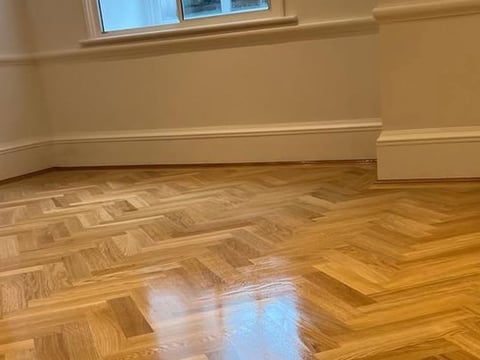
For older floors, especially those with oak parquet or engineered wood panels, you often have to deal with gaps, chips, and stains. Wood filler needs to be chosen carefully to match the expansion characteristics of the existing timber. A rigid filler will crack when the wood moves with the seasons. Flexible, water-based fillers are better for eco-conscious work because they contain fewer solvents and they move with the floor.
Stain removal on a wood floor is a different skill. Water rings, pet urine, and ink marks often sit just below the surface. The instinct is to sand deeper, but that can remove the original patina. With careful stain removal using oxalic acid or gentle bleaching agents, you can lift the mark without damaging the character of the wood. It is slower work, but it preserves the floor's history.
Commercial Sanding and Large-Scale Projects
Eco-friendly floor restoration is not limited to small residential jobs. Commercial sanding on a large scale, such as in a hotel lobby or a retail space, can generate huge volumes of waste if done poorly. Using high-efficiency dust containment on floor scrapers and sanders reduces the environmental load. It also means the business next door does not have to close while the work is happening.
For olympic flooring, which is often tongue-and-groove softwood used in sports halls and dance studios, the approach is different again. Here, the finish needs to be non-slip and durable, but also low-odor because the space is often in use soon after the work finishes. Water-based lacquer finishes and UV oil are the standard choices for that kind of environment.
Maintenance services also play a role in sustainability. A floor that gets regular buffing and recoating will last decades longer than one that is left to degrade until a full sand is the only option. That is where the simple habits matter: using a magic mop with a gentle cleaner, placing mats at entrances, and keeping grit off the surface. Those small actions reduce the need for aggressive restoration later.
Real-World Experience on a Recent Job
Last year we worked on a Victorian terrace in Islington. The original floor was a mix of pine boards and oak parquet in the hallway. The owners had young children and a dog, and they wanted something that would not offgas strong chemicals. They had heard about Osmo but were worried about durability. We did a test patch, explained the maintenance schedule, and they went with it. Two years later, the high-traffic areas needed a light recoat, but the rest of the floor still looked fresh. They were happy because they had not had to move out for the work, and they could spot-treat the worn spots themselves with a little guidance.

That is the kind of outcome that makes eco-friendly floor restoration worth pursuing. It is not about being perfect. It is about making better choices at each step: the finish, the preparation method, the maintenance plan. London Floor Restoration has been doing this since 2006, and the shift toward healthier materials and methods has been steady. Clients are better informed now, and they push us to keep learning.
Practical Tips for Anyone Considering Restoration
- Ask your contractor what dust collection system they use. If it is not dustless buffing with HEPA filtration, the air quality in your home will suffer.
- Do not assume water-based finishes are always the greenest. Check VOC content and look for independent certifications like the Blue Angel or EU Ecolabel.
- If your floor has historical value, consider a finish that allows spot repair. Hardwax oils and UV oils are easier to maintain than a thick polyurethane sealer.
- Plan maintenance from day one. A simple routine of dry mopping and occasional recoating will double the life of the floor.
Final Thoughts
Eco-friendly floor restoration is not a single product you can buy off a shelf. It is a set of practices that, taken together, reduce the environmental impact of keeping a wood floor beautiful and functional. It means choosing finishes that are safer to apply and live with, using equipment that contains dust rather than spreading it, and repairing rather than replacing whenever possible. If you are planning a restoration, ask the hard questions about materials and methods. The floor you save might be the most sustainable choice of all.